5 min de lectura
Por Maria Candelaria Carbajo
Viernes, 11 de Enero de 2024Circular Economy: The packaging challenges in the pet food industry.
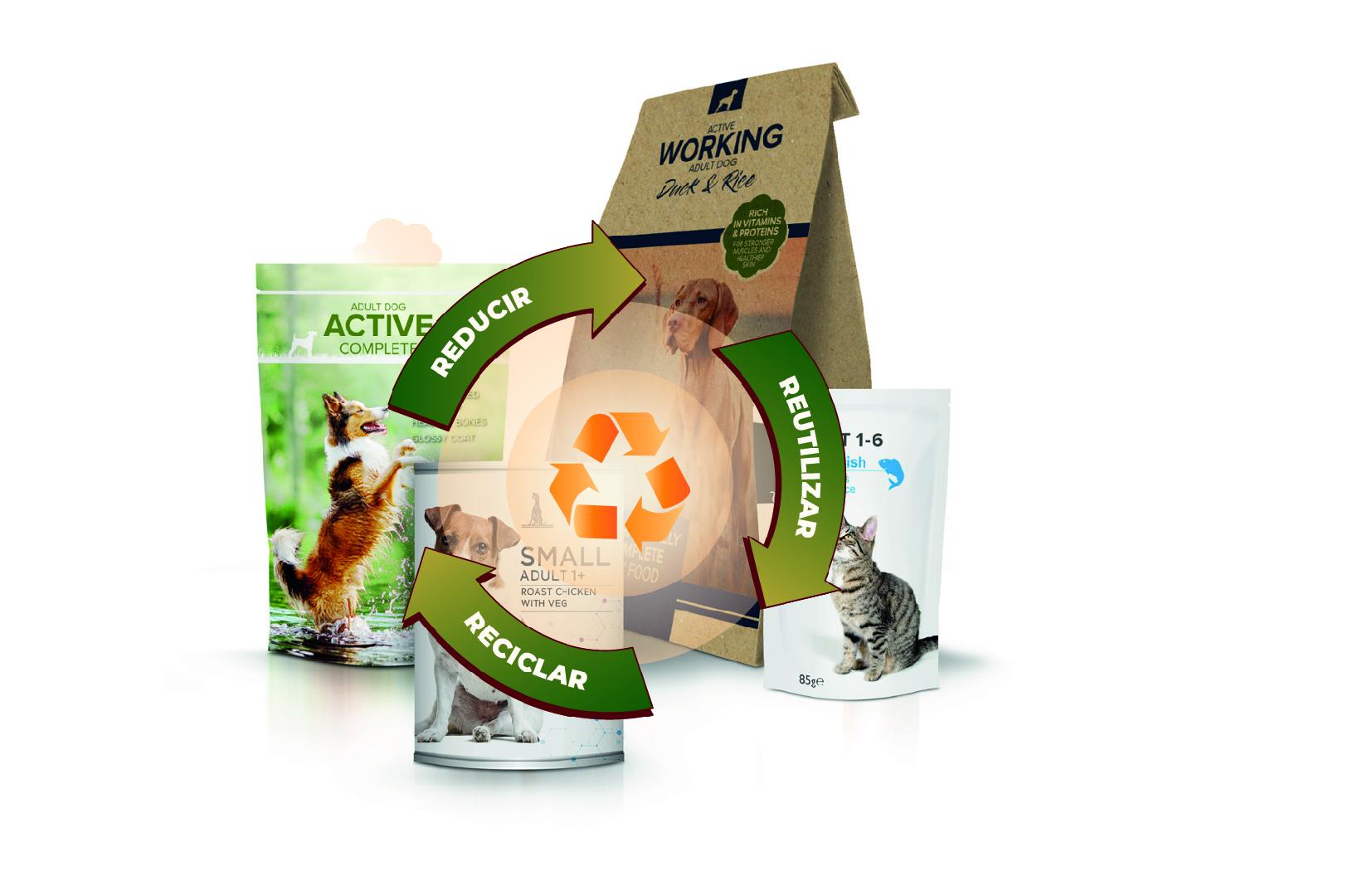
The circular economy has become a crucial approach to addressing the environmental and sustainability challenges we face at an international level. In particular, the pet food industry has come under scrutiny due to its use of plastics in packaging and associated environmental impacts. Today, most pet food packaging ends up in the trash, even those that could be recycled, reused, or returned to the stores.
The circular economy has become a crucial approach to addressing the environmental and sustainability challenges we face at an international level. In particular, the pet food industry has come under scrutiny due to its use of plastics in packaging and associated environmental impacts. Today, most pet food packaging ends up in the trash, even those that could be recycled, reused, or returned to the stores.

The truth is that the packaging that we had on the market 10, 20, or 30 years ago, when in many places the recycling system was just beginning to have relevance, has changed significantly, and there are strong indications that it will continue to do so. A few years ago, the same pet food companies began to analyze their packaging to find a way to achieve new, more efficient proposals in terms of sustainability and circular economy.
But what are we talking about when we talk about the circular economy?
A circular economy is an integrative approach that seeks to minimize waste generation and maximize resources reuse, recycling, and regeneration.
In contrast to the linear 'use and dispose of' model, a circular economy encourages the creation of closed systems where products, materials, and resources are kept in circulation for as long as possible. It promotes a systemic change from the traditional model towards a more sustainable and regenerative one.
The challenge, then, is not only focused in terms of sustainability but also on finding the most practical, functional, and attractive packaging for each product that hits the market.
The current situation in the pet food industry
Our industry has witnessed significant growth in recent decades, which has consequently led to an increase in the production of plastic packaging. These offer durability lightness, and practicality but also contribute substantially to environmental pollution and waste accumulation.
This market, like any other, generates waste and pollution on a daily basis, so trying to reduce it by working on one of the aspects with the greatest negative impact, the use of plastics in packaging, seems to be the most efficient option in the short and long term.
Often, there is a disconnection between what happens to a package at the beginning of its useful life when it is designed, and what happens at the end of its life. Currently, gaps of 5 and up to 10 years can be found between the environmental recovery situation for which a container is designed and what really happens with it when it goes on the market.
Considering the present context, not only of our industry but of the planet in general, it is undeniable to recognize that packaging plays an essential role in the food supply, protecting and maintaining the products from processing and manufacturing to distribution, handling, and storage to reach the final consumer. Without efficient packaging, food distribution would be completely incompetent and, therefore, much more expensive. The functions of a food package, both human and pet eats, can be described as protection and containment, preservation, information, convenience, and service. These are, directly or indirectly, essential for physical, chemical, and microbiological food safety. In pet food, the requirements for a packaging system intended for a fresh, frozen, dehydrated, thermal, or aseptic processed product, in terms of barriers to oxygen, humidity, light, and so on, are all different.
Reviewing the international situation, it is possible and clear to identify the efforts different companies and organizations are already making to find alternatives to a problem that will only increase, such as:
- Scientists at the Chinese University of Hong Kong (CUHK) have developed an edible, transparent, and biodegradable material with considerable potential for application in food packaging. The team is studying bacterial cellulose, an organic compound derived from certain types of bacteria that appears to be a sustainable, readily available, and non-toxic alternative to plastics.
- Analyzing the waste generated by plastic pet food containers, Dow, a leader in materials science, Nestlé Purina, a leader in the safe food market for animals, and the Avina Foundation, a civil society organization focused on addressing the social challenges in Latin America, created the Pegada Limpa project. The proposal is to encourage the creation of a recycling chain for pet food containers, promoting the conversion of 300 tons of circular plastic and positively impacting the income of approximately 5,000 collectors in Brazil and Argentina.
- Other alternatives under development focus on biogas energy. According to the U.S. Energy Information Administration, modern biodegradable waste can skip eons and go directly to energy production via landfill gas recovery systems. Gas from decaying organic matter can be captured and burned. Like natural gas, biogas contains mainly methane and carbon dioxide, both greenhouse gases if they escape into the atmosphere. However, when they are held trapped in a properly constructed landfill, that biogas can be used to generate electricity. In this case, the bioplastic waste of one person in the industry could serve as electricity for others.
What to focus on?
- Active development of sustainable alternatives to traditional pet food packaging materials, such as biodegradable and compostable materials, edibles, and smart packaging technologies. By adopting these revolutionary options, the pet food industry can significantly reduce its environmental footprint.
- Improving waste collection, classification, and recycling to minimize environmental impact.
- Seeking collaboration between involved parties. Governments, pet food manufacturers, packaging suppliers, and consumers must work together to create a sustainable ecosystem.
- Promoting sustainable change along with consumer education. We must encourage pet owners to make informed decisions and opt for sustainable packaging solutions to raise awareness of the benefits and environmental impact.
- Asking governments for measures that facilitate the transition towards a circular economy in the pet food packaging industry, with, for example, mandatory recycling programs or ecodesign requirements.
Pet food packaging: pursuing a more circular economy for our industry
It is well known that industries need to be increasingly aware of the impact on the environment and the well-use of resources. And, even though it is true that society has evolved towards a way of consumption that can be considered unbalanced and disproportionate with very harmful materials to the environment, awareness is also needed about the importance of generating and promoting change. Material suppliers and packaging producers, the recycling industry, food companies, the waste management sector, the public sector, and consumers are all collectively and individually responsible for environmental impact success.
Today, the circular economy presents a revolutionary opportunity for the pet food packaging industry to address the waste problem. By embracing sustainable packaging innovations, improving waste management practices, fostering collaboration, and educating consumers, we can create a more sustainable future for our industry.
By All Pet Food
Source: All Pet Food Magazine
Te podría interesar: Una investigación remarca que la comida cruda para mascotas es un potencial vector de salmonela y un riesgo para la salud pública

Sobre el autor
Maria Candelaria CarbajoCreativa interdisciplinar, traductora y redactora. Colaboro en la producción y redacción de proyectos creativos y de alto impacto para fomentar el intercambio cultural, transmitir valor diferencial y conectar con sus personas-audiencia. Me gusta el trabajo en equipo y unir fuerzas, experiencias y conocimientos para llevar al mundo todo el potencial que tienen las ideas que buscan impactar positivamente en la vida de los seres humanos.
Tendencias


23/02/2026
Estudio indica buena aceptación de la comida húmeda a base de insectos por parte de los perros
20/02/2026
Comida húmeda en verano: cómo las bolsas de comida húmeda pueden mejorar la hidratación de perros y gatos
Eventos

IBERZOO PROPET
11 al 13 de Marzo, 2026
Madrid, España
https://www.ifema.es/iberzoo-propet

Simposio CS Petfood & Aquafeed
15 al 16 de Abril, 2026
Pilar, Buenos Aires, Argentina
https://www.cliviosolutions.com/?lang=es

PET FOOD FORUM KANSAS
27 al 29 de Abril, 2026
Kansas City, Missouri, USA
https://www.petfoodforumevents.com/

interpack
07 al 13 de Mayo, 2026
Düsseldorf, Alemania
https://www.interpack.com/

Smart Pet Food Production
11 de Mayo, 2026
Sheraton Carlton Nürnberg
https://www.petfoodcompetencenet.com/events/

Interzoo 2026
12 al 15 de Mayo, 2026
Núremberg, Alemania
https://www.interzoo.com/en

FENAGRA 2026
12 al 14 de Mayo, 2026
Santana – São Paulo
https://www.fenagra.com.br/

XXIV CONGRESO DE PET DE LA CBNA
12 al 14 de Mayo, 2026
São Paulo Expo, Brasil
https://www.fenagra.com.br/congresso/cbna-pet/

EXPO PACK México 2026
02 al 05 de Junio, 2026
Ciudad de México, CDMX.
https://es.expopackmexico.com.mx/

VICTAM 2026
02 al 04 de Junio, 2026
Utrecht, Países Bajos
https://victaminternational.com/

VIV Europe 2026
02 al 04 de Junio, 2026
Utrecht, The Netherlands

Foro Mascotas 2026
24 al 26 de Junio, 2026
Expo Guadalajara, México
https://www.foromascotas.mx/en

Pet South America 2026
12 al 14 de Agosto, 2026
São Paulo Expo, Brasil
https://petsa.com.br/

Pet Fair Asia 2026
19 al 23 de Agosto, 2026
Shanghái, China
https://en.petfairasia.com/

CIPAL 2026
23 al 24 de Septiembre, 2026
Buenos Aires, Argentina
https://cipal.com.ar/?lang=es

PETZOO Eurasia
07 al 10 de Octubre, 2026
İFM- İstanbul Expo Center
https://petfuari.com/en/

SINPET 2026
15 al 16 de Octubre, 2026
Porto Alegre, Brasil
https://www.instagram.com/sinpet2026/

FIGAP 2026
21 al 23 de Octubre, 2026
Guadalajara, Jalisco, México
https://figap.com/

Pet Fair South East Asia
28 al 30 de Octubre, 2026
Bangkok, Tailandia
https://petfair-sea.com/
Publicidad